
Chongqing Jiangnan Sports Center is located near Yanyu Road in Nan'an District, covering an area of about 28,500 square meters. It includes public facilities such as a comprehensive gymnasium and an indoor swimming pool. The comprehensive gymnasium can accommodate 3,500 people, and the indoor swimming pool can accommodate 1,500 people. The surrounding residential areas are crowded with people and vehicles on weekdays. Chongqing Jiangnan Sports Center is not only the main place for local citizens to play sports, but also has a reputation for hosting heavyweight domestic basketball events such as the CUBA All-Star Game and the National Finals.
The stadiums are now operated by Ali Sports. With their own digital capabilities, they aim to rejuvenate the traditional stadiums and promote their transformation from being purely hardware suppliers of venues and equipment to more refined, digital software service providers, strengthening the sustainable growth capacity of the venues. This involves upgrading and transforming offline venues through technological empowerment and providing services such as face recognition, face recognition payment, online booking and pay-after-service. Parking management equipped with intelligent services is an important part of improving venue operation capabilities.
Difficulties in manual fee management
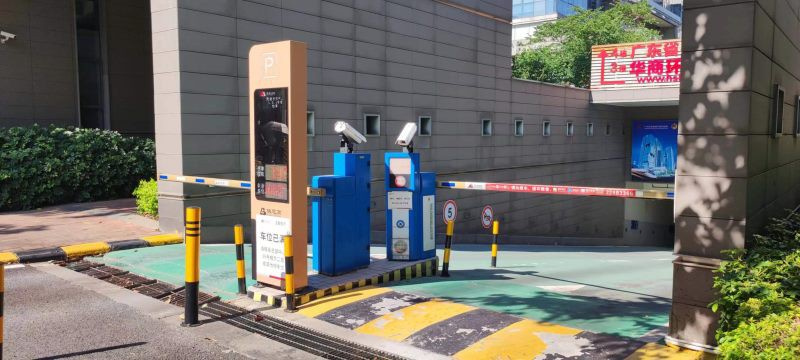
The parking lot of Chongqing Jiangnan Sports Center has four entry and four exit lanes, equipped with sentry boxes, and a total of 500 parking spaces. The venue has long relied on manual fee management. During holidays or events, the efficiency of vehicle access and parking becomes an important indicator of the venue's service capability. After reviewing the situation, there are three main difficulties with parking fees at the venue.
1. Manual management is difficult, and car owners have a poor parking experience.
Chongqing Jiangnan Sports Center is located in the core area of urban residents' life. Vehicles passing through the yard on weekdays include temporary vehicles, VIP vehicles and monthly permit vehicles, each with different procedures for charging management. When traffic flow is large during holidays, the traffic efficiency of the parking lot under manual management is relatively low, and the parking experience of car owners is poor.
In addition, besides gasoline vehicles entering and leaving, there is also a charging station for new energy vehicles in the parking lot that integrates charging and parking functions. Identifying and managing new energy license plates places higher demands on the traditional parking management model.
2. The cost of manual management is high, and the operator's expenses remain heavy.
Since each booth is equipped with at least two toll collectors who handle 24-hour toll management at the entrance and exit, and special personnel are also required for toll reconciliation, plus the cost of the power grid, this becomes a large fixed expense for the operator over time. How to truly reduce costs while increasing efficiency, so as to create profits for the operator and maintain a dynamic balance between the upstream and downstream of the industry, is also a major problem.
3. Operational data is not uniform, and order reconciliation is complicated.
The operation data of VIP cars, monthly permit vehicles and other vehicles can be collected relatively well, but it is not easy to obtain the charging situation of temporary cars and customer information, and it is difficult to manage the operation data in a unified way. In addition, there are other loopholes in the management of parking lot operations, such as favor lists and missing charges, which are difficult to supervise effectively and cannot provide data-based guidance for parking lot operations.
Many vehicles come and go in and out of the garage every day. Manually calculating order fees is not only complicated, but also prone to discrepancies during reconciliation, which is not conducive to overall data control. This is also a headache for the staff.
Using the COMA parking management system can easily help solve all of the difficulties above. It creates an unattended parking lot where customers can pay at an automatic parking payment machine. Every vehicle passing and every payment is recorded in the system, so everything becomes easy and clear.