
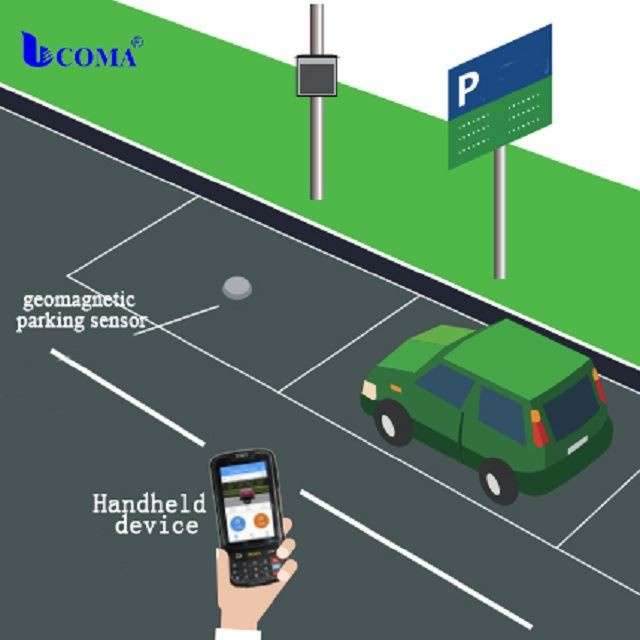
The COMA roadside parking system uses the principle of geomagnetic detection to detect motor vehicles. Wireless geomagnetism detects motor vehicles by analyzing changes in the earth's magnetic field. When there is no motor vehicle over the geomagnetic sensor, the earth's magnetic field is relatively stable and the system defaults to no vehicle; when a motor vehicle passes over the sensor, the earth's magnetic field is disturbed and changes, so the system determines that a car is present.
The wireless geomagnetic detector is buried below the surface and powered by its own battery. The vehicle information it detects (traffic parameters such as presence, flow, speed, vehicle length and occupancy rate) is sent wirelessly to the geomagnetic gateway installed at the roadside. The gateway then transmits the vehicle information to the cloud and other application systems through wireless signals.
The wireless geomagnetic detector is buried under the surface of the parking space. Whenever a vehicle is parked, the arrival of the vehicle is detected according to the change in the magnetic field around the detector. Once the vehicle stops and the signal is stable, the geomagnetic detector sends the signal to the geomagnetic gateway installed at a suitable location. Similarly, when the vehicle leaves, the detector identifies the departure from the change in the magnetic field and notifies the gateway.
System functions
- Real-time detection of parking spaces
The geomagnetic sensor detection method obtains basic parking space status data. The wireless geomagnetic vehicle detector, receiver and receiver base station form a data acquisition network, ensuring the real-time nature of the obtained parking space status.
- Data traceability and data statistics
The data uploaded to the platform by the receiving gateway is processed and stored permanently, providing big data channel support for traffic supervision units and parking lot management departments to analyze traffic data and manage parking lots in an orderly and standardized way.
- Charge supervision
The parking space management system based on wireless geomagnetism comprehensively processes the data obtained by the sensors, so it can produce accurate statistics down to each parking space, the number of parked vehicles per day and the length of each parking period, and calculate the corresponding fee through an algorithm. This effectively eliminates management loopholes and safeguards the interests of the parking lot.