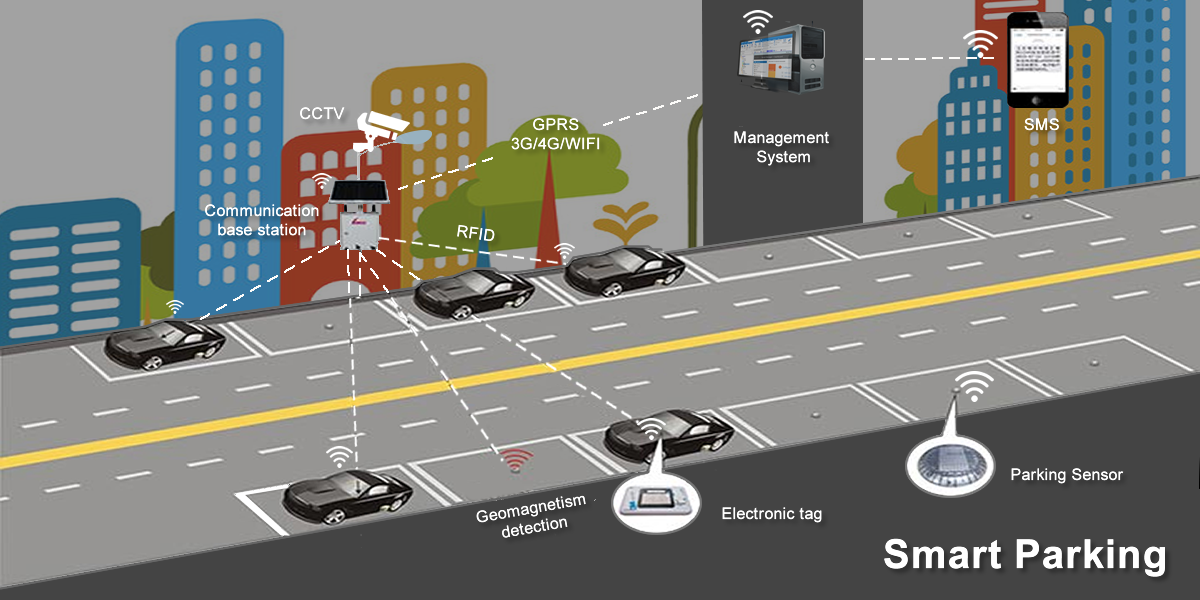
Smart Parking, Aided by Real-time Parking Information and Technology, to Be the Future of Parking
The aim of this research service is to provide a strategic overview of the parking industry and its stakeholders in Europe and North America. The study analyzes the key operational strategies of parking operators, parking app providers, and automakers, along with their implications for mobility integration. It also seeks to understand the major operational business models of parking operators and parking app providers in Europe and North America.
The study covers the major parking technologies used in ticketing, vehicle number plate recognition, and parking space availability. It compares the conventional and modern parking industry, which is now considered a significant part of mobility in cities.
Evolution of the parking industry
Parking facilities are going green and smart. They are experiencing an explosion of new parking applications for smartphones and mobile devices, and they are moving away from cash payments toward e-payment.
Parking management: parking industry evolution, Europe and North America, 1990-2015
1990s - Manually operated parking industry: parking personnel, paper-based tickets, mechanical parking, parking meters, zero automation, cash-based payments.
2000 - Significant level of automation: automated parking systems, license plate recognition, EV charging facilities, pay-on-foot machines, smart cards, and technologies such as RFID and CCTV.
2010 - Integration of web-based services and new technologies: pre-book systems, centralized network management systems, parking guidance, navigational assistance, and mobile payment technology.
Beyond 2015 - Smart parking and consolidation of services: real-time parking; cloud-based services; pay-by-text, pay-by-voice, and pay-by-phone; mobile apps for payment and reservation; parking analytics; in-vehicle parking reservation; and wireless sensor integration.
Executive summary - key findings and future outlook
Market status
Current: Five key global automotive OEMs have invested in, or shown interest in, the parking industry across different areas of integration, such as parking apps, parking garages, or infrastructure providers, and have expanded their portfolios.
Future: At least a number of automotive OEMs are expected to venture into the parking industry and demonstrate a higher level of integration.
Trends
Current: A key trend in the parking industry is connectivity and accessibility. Major parking operators in Europe and the United States are partnering with real-time parking information providers to help customers locate parking garages, check the cost and availability of vacant spaces, and reserve a space.
Future: Parking will become more integrated and will involve participants from the automotive, communication, infrastructure, and technology sectors working together. Parking will be a hot spot for mobility in cities and a dependable revenue generation model.
Solutions
Current: The US parking industry grosses billions of dollars annually for the millions of registered US passenger vehicles and adds to carbon dioxide emissions. Parking spaces total 160 billion square feet of concrete and asphalt.
Future: A number of potential private-public joint initiatives, such as SFpark, ParkIndy, and LA Express Park, have helped remove and recycle unused parking lots and garages. Smart, real-time parking will be the future.
Technology
Current: Today's parking industry is focused on automation solutions and basic software for parking reservations and payments.
Future: Future trends will incorporate adapted technologies from the communications and IT industries, such as M2M (machine-to-machine), IoT (Internet of Things), LBS (location-based services), cloud-based services, and mobile-based applications, all of which will integrate and work together.
Overview - parking ticket technologies
The trend for parking reservations is moving online and is also assisted by mobile-based bookings, which add value to conventional ticket technologies.
Technologies used for parking tickets
RFID (radio-frequency identification) windshield key tags: a state-of-the-art access solution that is easy to operate; the environmentally friendly key tags are easy to mount and PVC (polyvinyl chloride) free.
Pay-by-phone (SMS): used by Impark and LAZ parking companies with a Wireless Suite.
NFC (near-field communication) cell phone as a ticket: paperless tickets to the marketplace, from a simple ticket to a long-term parking pass, for example Mobile Parking Tickets in Vienna.
Pay-by-plate parking (automatic number plate recognition): the Calgary Parking Authority uses a pay-by-plate system assisted by highly sophisticated cameras.
Using a smart card, such as the P-card from Contipark: ticketless parking that can be monitored online with convenience.
Using a mobile app: APCOA uses a mobile app to pay for its parking usage.